
01
Infrastructure Migration
Move physical and virtual servers to Azure with target sizing, dependency mapping, network design and controlled cutover.
Discuss your workloadNiyocon Technologies helps organizations assess, architect and migrate infrastructure, applications, databases and data to Microsoft Azure—while building security, governance, resilience and cost control into the target platform from day one.
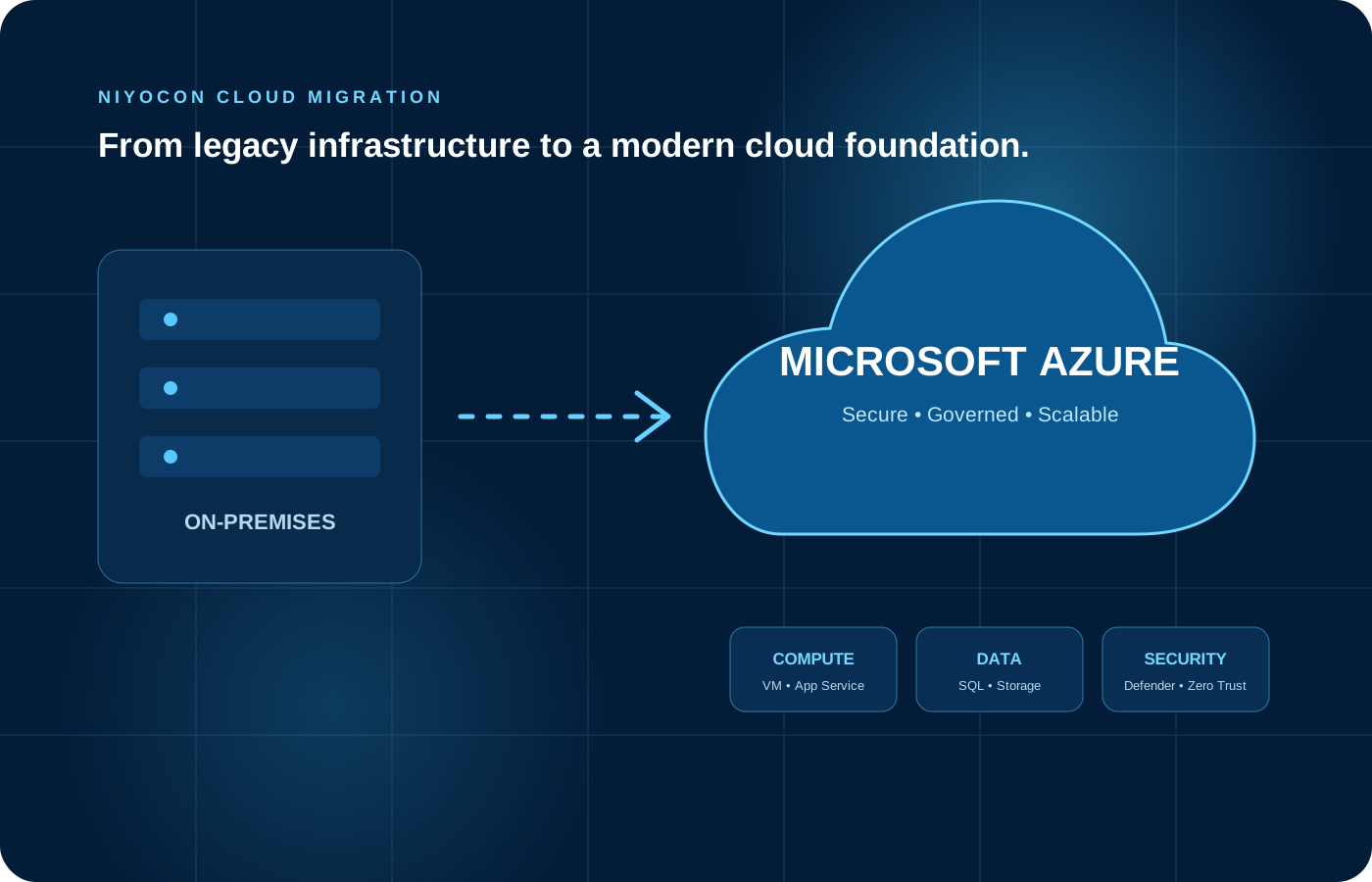
Successful migration begins with understanding what you have, why it matters, how systems depend on each other and what the business expects after the move. Niyocon turns that discovery into a practical target architecture and phased roadmap.
Instead of forcing every workload through the same path, we select the right treatment for each application—from straightforward rehosting to modernization, replacement or retention in a hybrid environment.
From ageing servers to business-critical applications, we design migrations around dependencies, downtime tolerance, security requirements and future operating costs.
Move physical and virtual servers to Azure with target sizing, dependency mapping, network design and controlled cutover.
Discuss your workloadRehost, replatform or refactor business applications based on complexity, risk, lifecycle and modernization value.
Discuss your workloadPlan secure migrations for SQL Server, PostgreSQL, file data and storage with integrity validation and recovery planning.
Discuss your workloadConsolidate workloads from AWS, Google Cloud or other environments into a governed Microsoft Azure platform.
Discuss your workloadUse Azure as a resilience platform with backup, replication, recovery orchestration and tested business-continuity procedures.
Discuss your workloadConnect Azure and on-premises estates with secure networking, identity, private access and operational visibility.
Discuss your workloadA cloud program should reduce technical debt, not simply relocate it. We classify workloads before execution so migration effort and future Azure consumption align with business value.
Move workloads with minimal architectural change to accelerate datacentre exit or hardware refresh.
Move to managed Azure services where practical to reduce infrastructure management and improve resilience.
Modernize selected applications to cloud-native patterns, APIs, containers, PaaS or serverless services.
Identify unused, duplicate or obsolete systems that should not consume migration effort or future cloud spend.
Keep workloads on-premises where business, technical, regulatory or dependency requirements justify a hybrid model.
Evaluate SaaS or modern platform alternatives where replacing a legacy workload delivers greater long-term value.
Our delivery model creates clear gates for architecture, security, validation and business sign-off rather than treating cutover as the only milestone.
Inventory servers, applications, databases, storage, network paths and dependencies. Establish business criticality, RTO/RPO, security and compliance requirements.
Classify workloads by migration strategy, prioritize migration waves, define success criteria and create a practical transformation roadmap.
Build identity, subscriptions, network topology, policy, security, logging, backup, tagging and governance before production workloads arrive.
Validate the approach with representative workloads, then execute migration waves with change control, replication, testing and rollback planning.
Run functional, performance, security and data validation; coordinate business sign-off and execute controlled production cutover.
Right-size resources, tune performance, establish monitoring and cost controls, transfer knowledge and transition into managed operations.
The target environment matters as much as the migration itself. Niyocon can establish a governed Azure foundation covering identity, networking, policy, security, observability, recovery and financial controls before production migration waves begin.
Explore Azure CloudEntra ID, MFA, Conditional Access and privileged-access design.
VNets, VPN/ExpressRoute planning, private endpoints, firewalls and segmentation.
Defender for Cloud, encryption, Key Vault, policy and workload protection.
Azure Monitor, Log Analytics, alerting, dashboards and operational baselines.
Sizing, budgets, tagging, reservations/AHB evaluation and consumption governance.
Backup, retention, replication, recovery objectives and tested failover procedures.
Cloud migration is often driven by a business event. The right architecture turns that event into an opportunity to simplify, secure and modernize the estate.
Talk to a cloud architectMigration is the beginning of the cloud operating lifecycle. Niyocon can continue with monitoring, security, backup, cost optimization, governance and platform improvement after handover.
Explore Azure Managed ServicesNiyocon reviews infrastructure, applications, dependencies, data, networking, identity, security, resilience requirements and current operating costs. The output can be used to classify workloads, estimate target architecture and create migration waves.
No. A sound migration program can include rehost, replatform, refactor, retire, retain and replace decisions. Some systems may remain on-premises as part of a secure hybrid architecture.
The approach depends on each workload. We use dependency mapping, replication or staged data movement, pilot migrations, test plans, business validation, change windows and rollback procedures to reduce operational risk.
Yes. We can assess virtualized server estates and design an Azure target architecture, migration waves, connectivity, backup, security and post-migration operations according to workload requirements.
Yes. Cloud migration can cover infrastructure, applications, websites, databases, file services and data. Where appropriate, we can also evaluate PaaS and application-modernization options rather than simply moving virtual machines.
We validate the environment, optimize cost and performance, document the platform, transfer knowledge and can provide ongoing Azure managed services covering monitoring, security, backup, governance and continuous optimization.
Assess your current estate, identify the right migration strategy for each workload and create a secure, cost-aware path to Microsoft Azure.